
朝5晚9
4,220-year-old rock art in SW China’s Yunnan reveals early cultural links with Southeast Asia_我的网站

A |
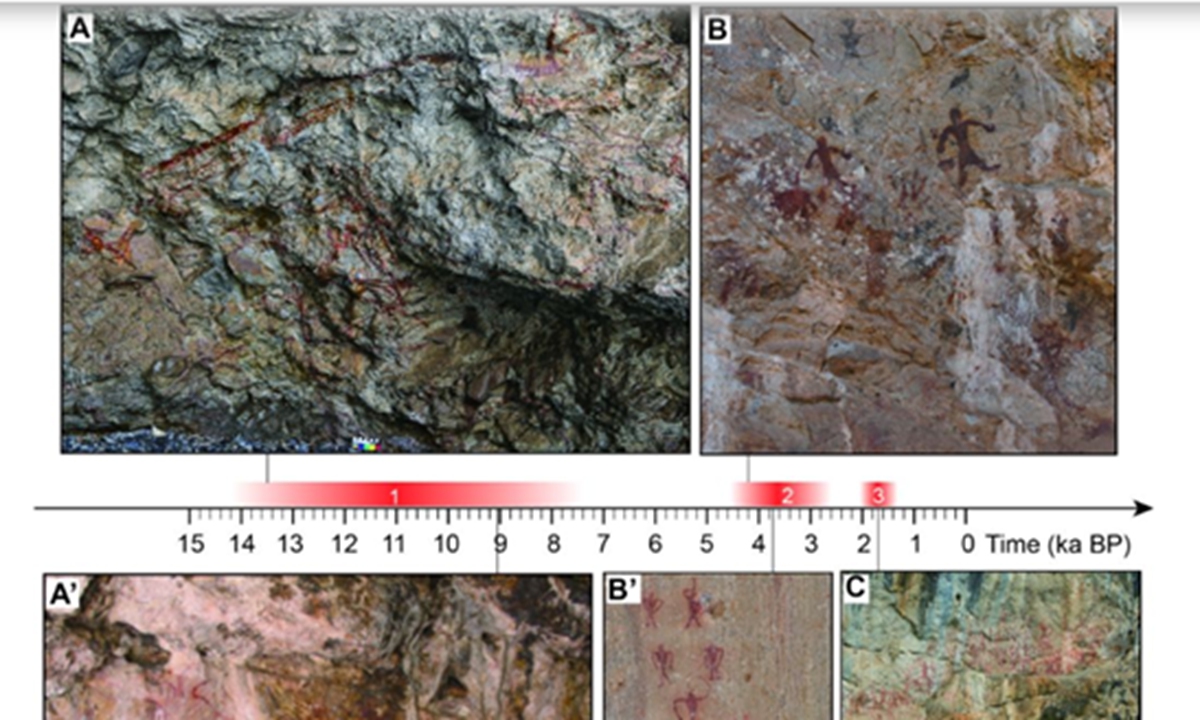
Chinese researchers have obtained the first absolute dates for rock paintings at the Mangguan rock art site in Southwest China's Yunnan Province, pushing the known history of rock art created by prehistoric settled communities in the region back to about 4,220 years ago. The paintings also suggest cultural interactions more than 4,000 years ago between Southwest China and civilizations along the Yellow and Yangtze rivers, as well as possible exchanges with neighboring parts of Southeast Asia, including present-day Myanmar, Thailand and Vietnam, a member of the research team told the Global Times.
The Yunnan Provincial Institute of Cultural Relics and Archaeology, in collaboration with Nanjing Normal University and other institutions, have recently made a significant archaeological breakthrough. Through systematic surveys and uranium-thorium (U-Th) dating at the Mangguan site in Gengma county, the research team obtained the first absolute dates for the site's rock paintings, tracing rock art created by prehistoric settled communities back to around 4,220 years ago.
The findings were recently published in the international journal Journal of Archaeological Science: Reports.
The Mangguan rock paintings represent one of the best-preserved prehistoric rock art sites in Yunnan. The research team presented high precision U Th dating of carbonate accretions that stratigraphically overlie the painted motifs at the Mangguan site, according to the paper published in the journal.
The dating results show that carbonate deposits overlying a human figure yielded a corrected age of 4,240 ± 19 years before present, confirming that ancient people living in the region had already produced mature figurative art at least 4,220 years ago, Wu Yun, first author of the paper and an associate researcher at the Yunnan Provincial Institute of Cultural Relics and Archaeology, was cited by the Xinhua News Agency report as saying.
Dating results from 11 samples taken from different motifs clustered between about 3,907 and 3,056 years ago. By comparison, the Cangyuan cliff paintings had previously been dated to roughly 3,800 to 2,700 years ago. The Mangguan paintings are therefore significantly older, filling an important chronological gap in the region's artistic record before the Cangyuan phase.
Shao Qingfeng, corresponding author of the paper and a professor at the School of Geography at Nanjing Normal University, told the Global Times that previous estimates dated the Mangguan rock paintings to a little over 3,000 years ago based mainly on imagery and comparisons with similar regional sites. Using microsamples of secondary carbonate deposits overlying the paintings, researchers have now obtained a precise minimum age of about 4,220 years before present without damaging the rock art.
The findings and the establishment of this chronological framework not only strengthen the archaeological foundation for studying rock art in Southwest China, but also provide a direct reference for rock art sites across Southeast Asia that have yet to undergo systematic dating, Shao said.
The findings may also challenge long-held perceptions of Southwest China around 4,200 years ago - roughly the era of the Xia Dynasty (c.2070 BC-C.1600 BC) - and help fill a key gap in understanding the pluralistic yet integrated development of Chinese civilization.
Shao said that while academic research has traditionally focused on the Yellow River and Yangtze River basins as cradles of early Chinese civilization, sites such as Mangguan and Cangyuan show that stable and culturally active communities also thrived in mountainous Southwest China. The newly established rock-art chronology brings an artistic dimension to the broader narrative of China's enduring cultural development.
Moreover, stylistic similarities suggest that Southwest China maintained exchanges with the Yellow River and Yangtze River regions and with early societies in Southeast Asia, providing material evidence of cross-regional interaction more than 4,000 years ago.
。 预防甲流,守护健康 ——预防甲流知识宣传 亲爱的家长朋友们: 目前正值甲型流感高发季节,预防流感等季节性高发呼吸道传染病不容忽视,为有效控制流感在幼儿园的传播与蔓延,今天我们来认识一下甲型流感,最大限度地保护幼儿。 了解甲型流感 流感病毒分为甲、乙、丙、丁4型,人流感主要是甲型流感病毒和乙型流感病毒引起。甲流全称为甲型H1N1流感,是一种急性的呼吸道传染病,为甲型H1N1流感病毒感染引起。

B | 可以通过呼吸道快速传播,甲流患者和隐性感染的病毒携带者为主要传染源,易引起大流行。 “甲流”有哪些症状? A. 早期高热,体温可达39~40 ℃,一般持续2~3天后渐退。 B. 呼吸道其他症状:流涕、鼻塞、打喷嚏、偶有咳嗽等 C. 消化道症状:部分孩子会出现恶心、呕吐、腹痛等。

C | D. 也可能伴有眼痛、畏光等症状。 “甲流”的传播途径 传播途径以空气飞沫为主,也可通过被病毒污染的物品间接传播,患儿发病后1—7天均具有传染性,病初2~3天传染性最强。 “甲流”和普通感冒的区别 做好家庭日常防护 减少去人多密集的地方 甲型流感病原主要通过人们呼吸道分泌物的飞沫传播。闭塞的房间也会让细菌和病毒密度上升,增加病原传染几率。

D | 因此,室内要多开窗通风,家长也应避免带孩子去人多的地方。如不可避免应采取防护措施。若孩子已确诊或疑似传染性疾病,请停止来园,同时告知班级老师避免传染他人。 远离“毒”源 家里有人感冒,应为患者佩戴口罩。确诊感染甲型流感病毒应及时治疗,以免传染给幼儿。引导幼儿在咳嗽或打喷嚏时用手帕或纸巾捂住口鼻。让幼儿远离甲型流感病毒携带者,避免与之近距离接触,以防感染。

E | 讲究卫生,勤消毒 让幼儿在家勤洗手,多喝水,保持良好规律的作息,以增强身体抵抗力。

F | 让幼儿在饭前便后洗手,拿了脏东西之后立即洗手。家人外出回来应洗手,换衣之后再与孩子接触,减少病毒感染几率。幼儿的餐具应定期灭菌消毒。除此之外,随着天气变化,及时为幼儿增减衣服。让幼儿进行适量的户外运动,保持室内空气流通,定期消毒等均可以降低患甲型流感的风险。 补充维生素 让幼儿多吃富含蛋白质和维生素的食物,促进代谢,提高免疫力。维生素能促进体内重要代谢,特别是维生素A和维生素C能增强皮肤和黏膜的功能,提高免疫力。平时注意教育孩子多喝水,饮食要有规律,不暴饮暴食。

G | 增强体质,锻炼身体 每天让孩子进行适当的户外运动。适当晒太阳,阳光中的紫外线,能促进幼儿生长发育,促进钙、磷吸收,增强免疫能力。也可通过适宜的运动和游戏活动,强健他们的身体,提高免疫力。 接种疫苗 接种流感疫苗是增强对病毒免疫力的有效方法,家长自愿让孩子接种。 家长需注意事项 1. 传染病流行季节,尽量少带幼儿去人群密集的公共场所,杜绝传染渠道,减少感染机会。 2. 合理安排户外活动,可增强幼儿自身免疫力。 3. 每天入园前请关注孩子的身体健康状况,当孩子出现发烧、呕吐、腹泻、疱疹等情况时,在没有明确病因前不要送幼儿入园,并及时与班级老师沟通孩子病因状况。 4. 请家长配合幼儿园做好每日的晨检工作,如果在晨检时保健医发现幼儿有异常情况,请您积极配合我们,及时带孩子到正规医院就诊。 幼儿园做好防控教育 预防甲流 我们在行动! ● 健康检测 坚持每日做好幼儿晨检、午检、晚检工作,关注孩子全日健康状况。

H | 监测幼儿体温,幼儿出现发热等症状,通知家长接回及时就医,并追踪随访。 健康检测 ● 精细化“服务” 关注气温变化,提醒家长送幼儿来园时及时增加衣物。每天会根据天气状况,带幼儿进行丰富多彩的室内外运动,增强幼儿体质。 引导幼儿养成良好的生活习惯,注意个人卫生,做到餐前、餐后,如厕前、如厕后、户外活动后、桌面游戏后勤洗手。 ● 校园、厨房、班级 卫生消毒工作严抓不懈 坚持把常规性和应急性消毒工作作为重点来抓,严格执行卫生消毒制度。

I | ● 健康知识科普 开展“幼儿健康教育”,将健康科普融入到孩子们的日常活动中。提醒家长特殊时期,尽量少带幼儿去人流密集、空气流通不畅的公共场所,经常组织教职工参加幼儿常见疾病预防知识培训,提高防病技能,做好疾病预防工作。

J | 滑动查看所有内容 预防流感 记住顺口溜 流感季,要记牢; 勤洗手,习惯好; 多通风,要防寒; 不聚集,戴口罩; 勤锻炼,打疫苗; 防流感,要趁早。 孩子是我们的未来,是我们的期望,维护孩子的生命健康是我们的共同职责。让我们团结一心,科学防范,为孩子们创造更加安全、温馨的成长环境! 注:文中部分图片来源网络公开渠道, 非商业用途,若有侵权,请联系删除。 文案:冯佩仪 排版:戴俊燊 一审|冯瑞莲 二审|冯雪峰 终审|范峻婷。
Current article:http://www.yuejinhuapennuochoudengying.cyou/xml38fj/20260826/933760.html
Published on:03:10:48
下一篇:浙江16岁男孩一个月暴涨20斤、确诊脂肪肝!妈妈懊悔:当时没阻拦!眼下正是高峰期,千万收着点……
 抚顺市多部门联合开展森林草原防火宣传周活动
 市场监管总局通报2026年度强制性产品认证(燃气燃烧器具及安全附件)有效性抽查情况
 Box Office Report: Tere Ishk Mein Races Toward The 100 Crore Mark in Just Five Days
 1—7月我国全行业对外直接投资6845.1亿元,同比增长2.8%
 Tibetan medical thangkas draw global spotlight at symposium in Xizang
 农家书屋丰盈乡村时光
- ·え、それだけ?「器の大きいリーダー」と「器の小さいリーダー」の“たった1つ”の違い
- ·Prithvi Shaw ने टीम इंडिया में वापसी के लिए कसी कमर! चीफ सेलेक्टर ने दिया बड़ा अपडेट; तारीफ भी की
- ·世界攀联亚青杯火热登场!中国队获三项预赛第一,狂揽半数晋级名额
- ·哈登将与骑士续签多年合同 均薪约2500万美元
- ·俄罗斯公布新一届政府名单
- ·日本熊灾,吓跑多少中国游客?
- ·Republicans Slam Biden For Allowing SPR Oil To Be Shipped Overseas
- ·OPPO Find X6系列爆料:将采用新款高像素长焦摄像头_机身背部_外观
- ·Delhi Crime: ऐसी हालत में मिली युवक की लाश, देखकर कांप उठे इलाके के लोग
- ·施罗德:退役后绝对不会定居美国 这里不适合我
- ·Box Office Report: Tere Ishk Mein Heads Toward The Rs 100 Crore Mark
- ·80-year-old Chinese illustrator receives 'Nobel Prize for children's literature'
- ·没有组织的进化,就没有AI的深层落地
- ·Paralyzed patient undergoes first BCI surgery at Tongji Medical College
- ·萨巴乞求奥胖决赛手下留情,奥胖:我最完美的比赛还没打出来
- ·警方举报“海地牢广播不良视频”:有人破解wifi密码投影屏
- ·Chinese Long March-8A rocket launches new internet satellites
- ·泽连斯基:乌克兰不会寻求加入北约之外的替代方案
- ·火箭媒体人:开局十场赛程艰难 六胜四负可接受
- ·CVS removing decongestant from shelves after FDA panel says it's ineffective
- ·杭州完整社区智能化服务等优秀经验获全国推广
- ·多式联运国家标准持续完善
- ·5部门对美团、滴滴等保障新就业形态劳动者权益开展行政指导_平台_企业
- ·乔布斯、库克都讨厌的触屏Mac,可能要被苹果做出来了
- ·订单排到2027年!中国“降温节水”神器在欧洲热卖
- ·全球首款全自主打网球机器人亮相,与运动员开展人机混双对打
- ·重要价格有了变化,出现哪些新机会?
- ·लुधियाना में दर्दनाक हादसा, छत गिरने से पूर्व वॉलीबॉल खिलाड़ी की मौत
- ·民盟济南市第十三次代表大会闭幕
- ·姚明谈篮球名人堂:要知道我们从哪里来
- ·板球成为2028奥运会候选项目
- ·OPPO 手机屏幕绿线质量故障,维修二次损坏,“过保就坏”,转嫁责任给消费者
- ·国务院国资委召开中央企业6G未来产业推进会
- ·四川内江市隆昌市发生3.0级地震,震源深度8公里
- ·全国抗议示威造成交通瘫痪 毛利党:这是一系列抗议行动的开始
- ·来烟台想尝本地特色风味 怎么选合适的海鲜餐厅
- ·众星云集!詹姆斯浓眉相聚参加高尔夫赛 追梦拉文范乔丹等人也在现场
- ·Adobe Express for Education已吸引超4300万K-12用户
- ·2026年A股剧烈震荡,散户为何越套越深?基金投顾的3个核心价值
- ·抚顺未成年人在法治教育中“沉浸式”成长