铁石心肠
Chinese diplomat involved in attack: MP_我的网站

一 | London, Oct 19 (UNI) One of China's most senior UK diplomats was involved in violence against protesters at the Manchester consulate on Sunday, a British MP says.
"What we saw was the Chinese consul-general then ripping down posters and peaceful protest," Alicia Kearns told MPs in the House of Commons, BBC reported.
China has not commented on Zheng Xiyuan's alleged involvement.
But the Foreign Ministry in Beijing defended the actions of consulate staff.
Spokesman Wang Wenbin said people had "illegally entered" the grounds and any country's diplomats would have taken "necessary measures" to protect their premises.
Foreign Secretary James Cleverly summoned Chinese chargé d'affaires Yang Xiaoguang -- the ambassador's deputy -- on Tuesday to demand an explanation for what happened at the consulate, the BBC reported.
The UK said it was reiterated at the meeting that all diplomats and consular staff based in the UK must respect the UK's laws and regulations.
The official Chinese version of what happened is at odds with video footage and statements from police.
Officers had to drag back a protester from inside the consulate gate as he was being attacked, the report said.
Earlier, Kearns told MPs that after Consul-General Zheng Xiyuan ripped down the placards, there was "grievous bodily harm against a Hongkonger, one of whom was hospitalised for taking part in a peaceful protest.
"Some were then dragged onto consulate territory for a further beating by officials who have been recognised to be members of the Chinese Communist Party (CCP).
"We cannot allow the CCP to import their beating of protesters, their silencing of free speech and their failure to allow time and time again protests on British soil. This is a chilling escalation."
According to a statement by the Greater Manchester Police, around 30 to 40 people had gathered outside the consulate to protest, the BBC reported.
"Shortly before 4pm a small group of men came out of the building and a man was dragged into the consulate grounds and assaulted," the statement said.
"Due to our fears for the safety of the man, officers intervened and removed the victim from the consulate grounds."
The consulate is UK territory, but cannot be entered without consent.
Another MP, Labour's Afzal Khan -- who represents the constituency where the consulate is, Manchester Gorton -- told the House of Commons he was "sickened" by the scenes.
"The UK stands for freedom, the rule of law, and democracy," said the Labour MP. "The quashing of peaceful protests will never be tolerated on British soil."
Khan and other MPs called for the consul-general to be declared a "persona non grata" -- meaning a person who is unwelcome in the country.
Conservative MP Sir Iain Duncan Smith asked if the government would "be prepared to expel the consul-general and any of those that are found to have been part of that punishment beating and the vandalism?"
Some MPs called for the Foreign Office to go further, including Labour's Andrew Gwynne who said: "Had these incidents happened on the streets of Hong Kong, there would have been outrage from the British government, rightly so.
"They happened on the streets of Manchester and yet we have this situation where the minister is basically sending a memo to the Chinese embassy, an offer of a cup of tea and a chat with the ambassador."
UNI MR。
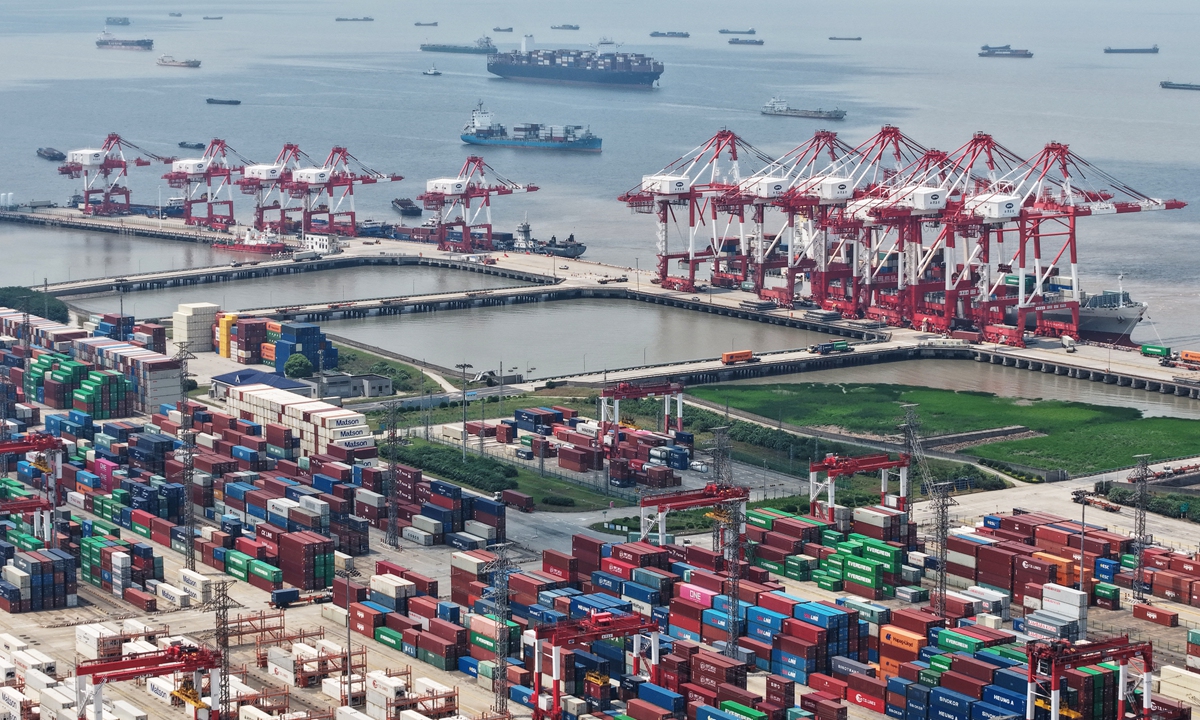
A busy scene at the Port of Shanghai on July 24, 2026 Photo: VCG
China's rapid rise in innovation capabilities has drawn broad recognition and positive assessments from the international community. However, some have taken a different stance, expressing concerns over China's technological and industrial advancement and even promoting the so-called "China Shock 2.0" narrative for various reasons, including the unfounded claim that China's industrial development is limiting others' growth opportunities.
A closer look reveals why this narrative does not hold up, for two fundamental reasons.
First, this narrative deliberately overlooks the inclusive, open and empowering nature of China's innovation.
China has always been a committed practitioner, active promoter, and major contributor to global economic, trade and technological cooperation. Through technological advancement and industrial upgrading, China has not only developed itself, but also provided the world with an increasing number of "innovation dividends."
For instance, digital economy, technological innovations in areas such as artificial intelligence applications, mobile payments and e-commerce have provided developing countries with valuable pathways for digital transformation. In the green energy sector, advances in China's photovoltaic, wind power and new energy vehicle industries have directly driven down the global cost of renewable energy, offering affordable solutions for countries tackling climate change. In consumer markets, high-quality, efficient, and cost-effective Chinese products have expanded global supply, reduced living costs and helped ease inflationary pressures worldwide.
Moreover, fast-growing Chinese innovation-driven companies have delivered returns of several times or even dozens of times for investors from around the world.
Companies from around the world can quickly find partners in China across the entire innovation chain, from research and development (R&D) and pilot production to mass manufacturing, making the commercialization of innovation more efficient.
They have not only succeeded in the Chinese market, but also strengthened their competitiveness globally. Facts have demonstrated that China's emerging technologies and products bring opportunities rather than shocks, and empowerment rather than threats to the world.
Second, it ignores the fundamental trends of technological innovation and the underlying dynamics of industrial evolution.
China's innovation has been built through years of strengthening its own capabilities. In recent years, the country has continued to increase investment in research and development, with its R&D spending ranking second globally.
Funding for basic research has reached a record high as a share of total R&D expenditure, while its pool of scientific and technological talent continues to expand. Through closer collaboration between the scientific community and industries, China has made rapid technological progress, driven continuous industrial upgrading and taken a leading position in some fields.
Innovation-driven development inevitably fuels industrial transformation and the dynamic reshaping of global production capacity, which is a natural outcome of international industrial division and cooperation.
For example, after years of technological accumulation, China has seized the opportunities created by the global green transition and developed competitive strengths in the "new trio" industries - new energy vehicles, lithium batteries and photovoltaic products - which have gained growing popularity in global markets. Portraying China's industrial upgrading as a "shock" is, in essence, a rejection of the broader historical trend of economic globalization.
"Innovation dividends" represent a positive-sum game, as the benefits of technological progress ultimately serve humanity. Distorting China's technological and industrial innovation and promoting the so-called "China Shock 2.0" narrative reflect outdated zero-sum thinking in some countries, while also revealing attempts to use criticism of China as a pretext to further advance protectionist policies.
Cutting through the rhetoric of protectionism, it becomes clear that the so-called "China Shock 2.0" narrative and "China overcapacity" claims are politically driven narratives that are detached from reality and lack factual basis.
Over the past decade, China has remained a major engine of global economic growth, contributing around 30 percent to global growth. In the past, China mainly provided the world with "market dividends" through its vast domestic market and cost advantages. Today, while continuing to offer greater "market dividends," China has also created "development dividends" by serving as a stable anchor and important hub for global industrial cooperation through its industrial growth. It is also providing the world with increasing "innovation dividends" through technological advancement.
China's market advantages, industrial development and technological progress are generating growing "market dividends," "development dividends" and "innovation dividends." These benefits, working together and reinforcing one another, are creating greater development opportunities and broader space for the world, offering a key perspective for understanding "China Opportunity 2.0."
Amid a complex and volatile international landscape and slowing global economic growth, innovation has become a crucial pathway to counter downward pressures and generate new growth momentum. Addressing global growth challenges requires greater cooperation in innovation. Rather than spending efforts on crafting the "China Shock 2.0" narrative, some countries should focus on domestic structural reforms and enhance their industrial competitiveness through openness and cooperation.
Embracing China means embracing the future. By using technological innovation to drive industrial innovation, China is accelerating the development of new quality productive forces. At the same time, China continues to expand high-level opening-up and provide new opportunities for the world through its own development. A more open and innovation-driven China will continue to deliver greater development dividends and work with countries around the world to build a more prosperous future.
This was compiled and translated by the Global Times English edition based on an article published in the "Chisu Jinsheng" economic commentary column of the People's Daily on August 7, 2026.。

二 |
Current article:http://www.yuejinhuapennuochoudengying.cyou/vlm69n/20260826/581969.html
Published on:12:42:46


 发表于 20:42:56
 QQ好友和群
 QQ空间
QQ空间 腾讯微博
腾讯微博 腾讯朋友
腾讯朋友 收藏
收藏 支持
支持 反对
反对
 发表于 13:25:21


